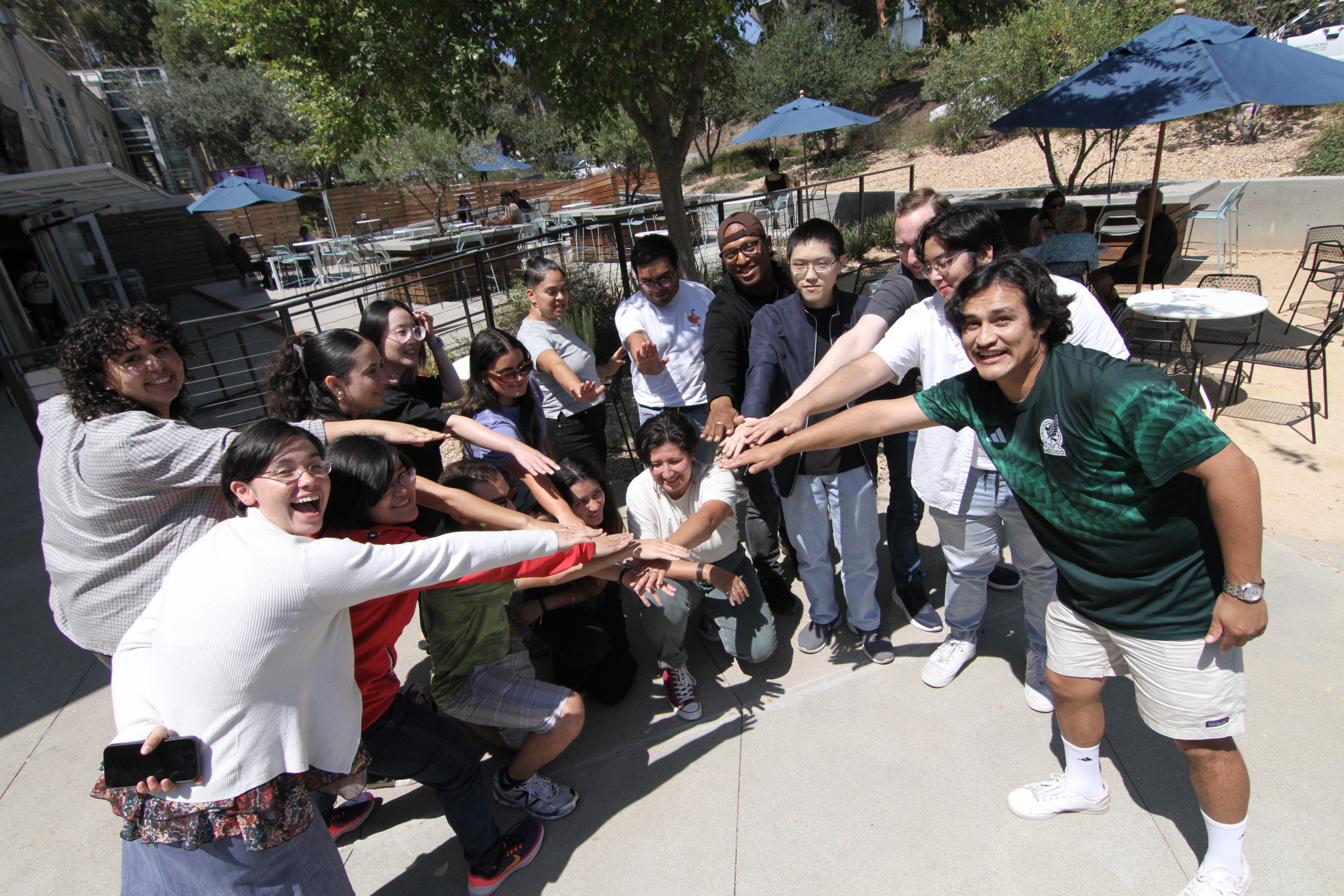
The latest grants strengthen and expand the Preparing Accomplished Transfers to the Humanities (PATH) program, a collaborative transfer student support effort led by the SDCCD and UC San Diego’s School of Arts and Humanities. Titled Integrating the Arts & Humanities for a Career and Social Justice Impact, the four-year partnership focuses on faculty development, curricular innovation, and career preparation. This will be achieved by establishing a Humanities4Careers paid internship program, enhancing a Ph.D. fellowship program, mentoring students in a year-long social justice research project, providing workshops, and panel discussions focused on equity practices and career options, and more.
“Our mission at the San Diego Community College District has always been to empower
students through inclusive and forward-thinking educational programs,” said Susan
Topham, SDCCD Vice Chancellor of Educational Services. “PATH 3.0 exemplifies this
mission by fostering collaboration between institutions, bridging education and career
opportunity gaps, and embedding a strong foundation of social justice principles into
the humanities.”
Said UC San Diego School of Arts and Humanities Dean Cristina Della Coletta: “We are thrilled to be
able to continue strengthening our institutional partnership with additional support
from the Mellon Foundation. The PATH program invites faculty and students to reflect
upon personal and collective values while working together to advance the common good.
Students will emerge fully prepared to succeed in diverse career fields ranging from
public service and education to health and policy.”
The PATH program began in the fall of 2016 when the Mellon Foundation awarded UC San
Diego and the SDCCD a pair of grants totaling $2.59 million over three years to support
underrepresented humanities students who are interested in transferring to UC San
Diego. Participants benefited from mentorships, workshops, a summer academy, campus
visits, and more.
Phase II, which came with an additional $2.7 million in January of 2020, included
new service-learning opportunities and a PATH Integrated Fellowship Initiative focused
on developing innovative cross-institutional training for Ph.D. students interested
in teaching or otherwise serving within the region’s community colleges. Doctoral
fellows mentored SDCCD students, job-shadowed faculty and administrators, and guest
lectured SDCCD courses.
Phase III will include a range of activities centering on three goals:
Faculty development: A Faculty Professional Development Collaborative will be developed to provide training and resources for faculty to integrate career development and social justice principles into existing humanities courses. Additionally, a Community of Inquiry will invite faculty to create new approaches in team-teaching, syllabi design, project-based learning, and career networking.
Curricular innovation: Through the Community of Practice, faculty will apply their learnings. The resulting refreshed courses will provide experiential learning opportunities and research projects that prepare students to present at conferences. In addition, students will be invited to attend career exploration events and enhance their marketable skills through numerous work-learning programs.
Career preparation: Students can take part in paid internships through the Humanities4Careers program,
which will include biweekly check-ins, targeted workshops and career-oriented field
trips. Additionally, Ph.D. students from UC San Diego will mentor students in a year-long
social justice research project, as well as explore teaching opportunities at SDCCD
by co-creating lesson plans, evaluating assignments and more.
Several faculty members from both institutions collaborate to lead professional development
for peers, curricular innovation and student engagement. UC San Diego Professor of
History Danny Widener serves as the university’s faculty director of the PATH program.
Faculty members Kelly Mayhew (City College, English), Pegah Motaleb (Mesa College,
English) and Carmen Carrasquillo (Miramar College, English) serve as program leads
at their respective SDCCD colleges.
Why focus on the humanities? “This work is both needed and urgent,” said Dean Della
Coletta. “As we face unprecedented local and global challenges, the values that underpin
a humanistic education have become even more critical to foster. Arts and humanities
education addresses the whole individual by building resilience, growing empathy and
developing a shared sense of purpose.”
According to the American Academy of Arts and Sciences, the number of humanities degrees conferred by four-year colleges and universities
has dropped every year since 2012. That has not been the case locally. For the past
eight years, UC San Diego and the SDCCD have demonstrated tangible success in Mellon-funded
collaborative efforts. Applications to the university from SDCCD transfer students
have increased by 60% between 2015 and 2024. In addition, School of Arts and Humanities
majors have grown more than 78% over the same period.
By bolstering the transfer prospects of community college students to UC San Diego
and advancing their career readiness, the latest iteration of the PATH program seeks
not only to ensure the continued relevance and career viability of humanities degrees,
but also to nurture a new generation of leaders and professionals who can enrich both
the academic landscape and social justice discourse.
Said Topham: “PATH 3.0 is a powerful example of what can be achieved when institutions
work together with a shared vision. By integrating career development with social
justice principles, we are equipping our students to excel academically and make meaningful
contributions to their communities and beyond. This initiative strengthens our commitment
to providing equitable and transformative educational opportunities for all students.”
About UC San Diego
At the University of California San Diego, a culture of risk-taking, collaboration
and innovation emerged early on. Established in 1960, UC San Diego has been shaped
by exceptional scholars who aren’t afraid to push boundaries, challenge expectations
and redefine conventional wisdom in order to make our world better. The only criterion
our founders had for their campus was that it must be distinctive – and being experimental
has been the norm since day one.
Learn more about UC San Diego.
About the San Diego Community College District
As one of the largest of California’s 73 community college districts, the San Diego Community College District serves approximately 90,000 students annually through its four colleges. San Diego City College, San Diego Mesa College, and San Diego Mesa College offer associate degrees and certificates in occupational programs that prepare students for university transfer and good-paying careers. The credit colleges also offer bachelor’s degrees in high demand fields such as Health Information Management, Cyber Defense and Analysis, and Public Safety Management. San Diego College of Continuing Education, a statewide leader in noncredit education, offers free, adult education programs at seven campuses throughout San Diego.