San Diego Community College District Chancellor Gregory Smith responds to the Governor's May Revision budget proposal.
Here are some key takeaways:
Strong stock market returns have led to a sharp increase in current-year revenues, but the Governor’s economic forecast shows concerns about the sustainability of these gains. The Governor’s May Revision provides some additional support for California’s Community Colleges:
-
Significant investment in the Proposition 98 Rainy Day Fund to protect against future revenue shortfalls.
-
Exhibiting extreme caution, the Governor leaves $3.9 billion of current year Proposition 98 funding unallocated pending future developments.
-
COLA is proposed at 4.31% for the Student-Centered Funding Formula – a “super COLA” that goes beyond the 2.87% statutory requirement.
-
Select categorical programs would receive the 2.87% COLA.
-
COLA would not apply to Strong Workforce or the Student Equity and Achievement programs.
-
Enrollment growth funding remains at 0.5% for 2026-2027 with an additional 1% for 2025-2026.
-
$120.7 million in one-time deferred maintenance funding is proposed.
-
One-time $100.6 million student support block grant, a $607,000 increase from the January proposal.
Governor’s Budget Proposal Overview
On May 14th, Governor Gavin Newsom presented a revised budget proposal for the 2026-2027 fiscal year as required by law. The “May Revision” updates revenue and expenditure estimates for current and future years based on more recent tax collection and economic data. Over the next few weeks, analysis, advocacy, and negotiation between the Assembly, Senate, and Governor’s office will culminate with a final approved budget in late June. In the coming days, we will learn more details of the proposals and share as relevant. We will also engage in advocacy to craft a final budget that is more favorable to our students, faculty, classified professionals, administrators, and operations.
While the May Revision reflects a more optimistic outlook on the state’s revenue situation than what was presented in January, serious cautions remain for what the future holds. The increases in state revenues are largely due to capital gains tax revenues from strong stock market performance. We cannot assume those revenues will continue year after year as stocks, particularly in the tech sector, are highly volatile.
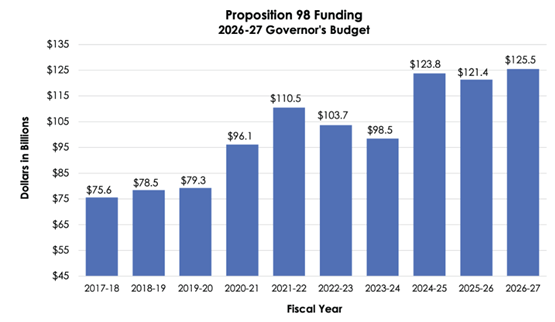
The state’s General Fund budget is $245.8 billion in the current year and would increase slightly to $246.6 billion in FY27. This reflects caution about the sustainability of the current year revenue spike. Specific to public education, the Proposition 98 guarantee is projected to increase by $6.4 billion over the 3-year window relative to the January proposal, with much of these funds to be transferred to the Proposition 98 Stabilization Account (Rainy Day Fund). Thus, the new revenues lead to relatively modest increases for the community colleges relative to the January proposal. In contrast, K-12 budgets receive far greater increases, owing in large part to funding room created by declining enrollments. The mismatch in funding will be a point of advocacy over the coming weeks.
Local Impact
Overall, the proposed budget is welcome news for the San Diego Community College District. The enhanced COLA will ensure we have additional revenues to cover increases in employee salaries, retirement system contributions, health insurance premiums, parental leave benefits, and operational expenses. The growth funding will ensure we can continue increasing enrollment opportunities for our local communities. The one-time resources proposed will allow us to better support the basic needs of our students in the short-term and address facility needs at our college sites.
SCFF and Categorical COLAs
The 4.31% COLA for the SCFF will add an estimated $14.6 million to the District’s base revenue under the SCFF. The estimated value to our District is based on enrollment projections for the current year, so the precise figure may change. The exact increase in revenue will be determined once final enrollment data and other factors are reported for the year. With this enhanced COLA would come a requirement for districts to provide 14 weeks of paid pregnancy leave. The 2.87% COLA for select categorical programs will increase funding for the Adult Education, EOPS, DSPS, Apprenticeship, and CalWORKs programs. As with recent prior years, Strong Workforce and SEAP are not proposed to receive a COLA increase.
One-time resources
The increase in revenues grows the Proposition 98 minimum guarantee in the current year, which allows the Governor to propose significant new one-time resources, including $120.7 million for deferred maintenance and $100.6 million for the Student Support Block Grant.
Other one-time items include $37M for Credit for Prior Learning, $38 million for Calbright, and $41 million to support the build out of the Common Cloud Data Platform.
Areas of Uncertainty
While the increase in revenue for the current year is beneficial, it is less clear how much of it will continue into the future. State revenues are largely dependent on stock market performance, which is difficult to predict. There has been much speculation that stock market valuations are excessive and disproportionately attributable to an AI bubble that may not be sustainable. If the markets fall, we would likely experience a significant negative impact on FY27 revenue estimates. The federal administration further injects significant unknowns into the economic picture and as to how federal funding is applied nationally and to the state of California specifically.
In Conclusion
The 2026-2027 May Revision invests in our base funding through the super-COLA and growth funding. State revenues have outpaced projections in the current year and we appear to be in a much healthier place, fiscally, than was anticipated. Our District has done well in growing enrollment, increasing our Student-Centered Funding Formula revenues, and moving out of the hold harmless protections in the funding formula. We have built stronger general fund reserves and have resources to continue supporting our diverse student communities should current funding sources be impacted.
Stability in our state funding is critical to our ability to persist through any volatility we may experience in federal programs. While we believe there is room to shape the budget in ways more favorable to our students, for example, we will advocate for more growth funding and increases for SEAP and Strong Workforce, the Governor’s May Revision proposal continues the state’s commitment to high quality, accessible public higher education for every member of our San Diego area community.